

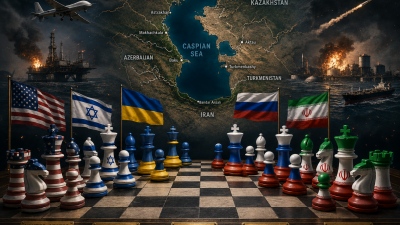
At the exact moment Israeli Prime Minister Benjamin Netanyahu and Ukrainian President Volodymyr Zelensky are in the US—where they are expected to hold meetings with US President Donald Trump and members of the Senate—a nightmare scenario has begun to emerge. The wars in Iran and Ukraine have merged into a hot front in the Caspian Sea, the world's largest inland body of water. This is a dramatic and particularly dangerous development as it brings the two largest nuclear superpowers, the US and Russia, along with their allies—Israel, Iran, Ukraine—closer to a direct military confrontation, creating an uncontrollable situation. This constitutes an extremely dirty plan that Zelensky wants to sell to Trump to demonstrate how faithful an ally Ukraine is. At the same time, Iran is warning Ukraine of terrifying retaliatory measures and unpredictable consequences. And while the flames of war ignited in the Caspian, Iran is planning to shake up the Strait of Hormuz, determined to move forward with imposing transit fees, at least for Western vessels.
New front in the Caspian
The Caspian Sea has emerged as the newest arena of expanding confrontation between Iran and its adversaries, primarily because it serves as a vital artery for deepening Iran-Russia ties. Ukraine announced over the weekend that its drones struck two Russian vessels carrying military cargo in the Caspian Sea, the world's largest enclosed body of water. According to Kyiv, both ships had departed from Iran bound for a Russian port facility. In a post, Ukrainian President Volodymyr Zelensky stated that the targets included "vessels involved in transporting military cargo from Iran, as well as a warship," which the Ukrainian security service later identified as a Russian missile corvette. According to former US Ambassador to Kazakhstan and Georgia William Courtney, by attacking Iranian ships, Kyiv not only serves its own strategic interests but also strikes Washington's top adversary, a move likely to satisfy the US. However, he added that while Zelensky supports sanctions against Iran within the framework of the Russia bill, Ukraine would hardly wish to be closely identified with an unpopular US war against Iran.
Iran: Terrifying retaliation coming to Ukraine
Iran responded that one of its commercial ships carrying a cargo of iron was hit, killing one sailor and wounding three others. The unnamed vessel was en route from the Russian port of Astrakhan to Anzali in Iran. Regional Governor Hadi Hagh-Shenas described the specific route as a safe commercial corridor between the two ports. Tensions escalated further on Monday, July 27, when Iranian Foreign Ministry spokesman Esmail Baghaei stated: "This action by Ukraine was entirely illegal and unjustified, contrary to the United Nations Charter, and constitutes a dangerous act of adventurism that will certainly not remain unanswered by us." For his part, Iranian Foreign Minister Abbas Araghchi asserted that "Zelensky attacked an Iranian commercial ship" and that the strike was ordered by Israel to drag Europe into Israel's broader conflict. Indeed, Ukraine's chargé d'affaires in Tehran was summoned to the Iranian Foreign Ministry for explanations.
Why the Caspian Sea is acquiring such immense importance
The growing tension reflects the strategic importance of the Caspian Sea, which borders five nations, including Iran and Russia. Following the blockade of Iranian ports in the Persian Gulf and the Gulf of Oman, the Caspian acquired even greater value as an alternative trade route. Bijan Khajehpour, managing partner of Vienna-based consulting firm Eurasian Nexus Partners, stated that the Caspian can help Iran implement a more diversified commercial strategy, particularly by boosting trade with:
• Russia,
• the Caucasus,
• Central Asia,
• China via rail networks,
• and, indirectly, Eastern Europe.
As he pointed out, the Caspian does not replace Iran's southern maritime routes, but functions as their vital strategic complement.
Critical trade and energy route
Through the Caspian, commodities such as Russian grain, Russian steel, and Kazakh oil and natural gas transit toward terminals in the Black Sea basin. Iran has developed substantial port infrastructure in the region, with its primary facility at Bandar Anzali. For Russia, the Caspian forms a key corridor connecting to Iran and Central Asia, serving as a critical pillar of its deepening strategic partnership with Tehran, which includes military cooperation, participation in Iran's civil nuclear program, and joint oil exploration. According to Khajehpour, the recent blockade of Iranian ports by the US further highlighted the strategic value of the Caspian route, which is less vulnerable to international sanctions pressure because it is an enclosed sea controlled primarily by Iran, Russia, and neighboring states.
Military cooperation corridor
The Caspian has also developed into a primary transport route for military equipment between Moscow and Tehran. Iran and Russia have signed a broad strategic cooperation agreement in economic and military sectors, though it does not constitute a mutual defense pact. In the early stages of the war in Ukraine, Russia received its initial batches of Iranian Shahed attack drones via the Caspian, before subsequently manufacturing advanced variants in domestic Russian factories. This maritime route has been targeted by Ukraine in the past. Last August, the cargo ship Port Olya 4 was destroyed while reportedly carrying Shahed-136 drone components and Iranian artillery ammunition. In 2024, CNN revealed that a Russian cargo vessel suspected of transporting Iranian ballistic missiles to Russia was tracked at a Caspian Sea port. As noted by EurAsian Times, Russia uses the Caspian Sea to send attack drone components back to Iran, assisting in replenishing Iranian stockpiles, while a report by the New York Times cited Iranian officials stating that efforts to build alternative trade routes are moving rapidly, with four Caspian ports—Amirabad, Bandar Anzali, Nowshahr, and Caspian Port—operating on a 24-hour basis to handle wheat, corn, animal feed, sunflower oil, and other bulk goods.
Russian exports
Similarly, Russian officials state that cargo transit through the Caspian has increased significantly in recent months. Approximately 2 million tons of Russian wheat, previously transported annually to Iran via the Black Sea, are now routed through the Caspian due to the threat of Ukrainian drone attacks. Between July and February, Iran imported nearly 6 million tons of Russian grain, double the volume recorded during the previous annual period. Russia operates three grain export ports on the Caspian—two in Astrakhan and one in Makhachkala—with a combined capacity of at least 3 million tons, while a new terminal with a capacity of 1.5 million tons is expected to be completed by 2028.
Transport of ballistic missiles
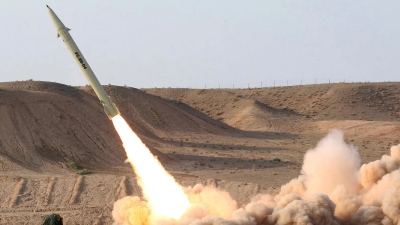
The US Department of the Treasury previously assessed that the Russian Ministry of Defense used the vessel Port Olya-3 to transport short-range ballistic missiles from Iran to Russia. Then-US Secretary of State Antony Blinken stated Washington believed Russia had already received Fath-360 missiles from Iran and would likely deploy them in operations in Ukraine. The US National Security Council also warned of steadily deepening military cooperation between Iran and Russia, framing potential new transfers of ballistic missiles as a severe Iranian escalation. Iran rejected the accusations at the time regarding military assistance to Russia.
CNN: What Ukraine is seeking
According to a CNN analysis, Ukrainian drone attacks against ships and energy installations in the Caspian demonstrate:
• the significant enhancement of Ukrainian long-range strike capabilities,
• the effort to target industries supporting the Russian war effort,
• the recognition that Iran, like North Korea, plays a critical role in arming Russia.
"We are on the same side"
The timing is considered particularly significant as Zelensky is in Washington for a meeting with President Donald Trump. Parallel to the attacks in the Caspian, Zelensky stated that according to Ukrainian intelligence, Russia provided Iran with satellite data used for strikes against US regional installations. The core message Ukraine seeks to convey to the United States is clear: "We are on the same side." In this manner, Zelensky hopes his meeting with Trump will yield a positive strategic outcome. It is highly likely that his meeting will coincide with the promotion of severe new US sanctions targeting Russian energy exports. Zelensky, who will attend the funeral of US Senator Lindsey Graham, is also scheduled to meet with members of the Senate leadership later.
Vote on new sanctions against Russia
The vote on the Russia sanctions bill, which has been pending for months and was championed by Graham, may take place on the very same day. If approved, the bill would significantly increase pressure on Moscow by imposing 100% tariffs on products originating from the five largest importers of Russian oil and gas, including China and India. At the last minute, Trump attempted to incorporate sanctions targeting Iran into the same legislative package. Zelensky stated last week to close Trump ally Laura Loomer that he considers this move an outstanding strategic idea.
Improvement in Trump–Zelensky relations
Despite their intense clash at the White House in February 2025, relations between Trump and Zelensky have improved noticeably in recent operational months. Earlier this month, the two leaders agreed to allow Ukraine to participate in the joint production of interceptor missiles for Patriot air defense systems, a critical element for protecting the country against Russian air strikes. Concurrently, the two nations are closer to an agreement on joint production of unmanned aerial vehicles, a partnership that could help the US address its technology gap in a field where Ukraine has acquired unmatched battle experience. Ukraine is projected to manufacture 6 to 7 million short-range attack drones within the year, whereas the Pentagon's $1.1 billion production program is expected to order fewer than 200,000 drones in total by February 2027.
Iran sets Hormuz ablaze – Preparing transit fees with Oman
Iran and Oman will decide what transit fee will be imposed on ships from Western nations passing through the Strait of Hormuz, Iranian Ambassador to Moscow Kazem Jalali told the Russian news agency TASS. "On this issue, Iran and Oman are currently in negotiations. As stated by the authorities and the Ministry of Foreign Affairs of the Islamic Republic, Iran and Oman jointly make decisions regarding the security of the Strait of Hormuz and the transit regime for vessels," Jalali noted. "Compensation for transit services through the Strait and the amount of the relevant fee are subjects of our negotiations. Appropriate decisions on these matters will be made in the future," he added. Earlier, Jalali told TASS that Tehran would maintain a special transit regime for Russian flagged vessels passing through the Strait of Hormuz. Approximately 25% of global oil trade and nearly 20% of global liquefied natural gas (LNG) trade transit through the Strait of Hormuz.
Tasnim: Hormuz is Iran's primary leverage over the US
Any negligence or downplaying of the importance of the Strait of Hormuz could carry irreparable consequences that would not be easy to remedy, Iranian news agency Tasnim highlights in an analytical overview report. Seyed Mohammad Taheri, head of the agency's military analysis division, stated: "The Strait of Hormuz currently represents Iran's primary instrument of leverage against the United States. Maintaining control and preserving its significance will undoubtedly yield strategic benefits for Iran. We must not abandon our position in the Strait in pursuit of temporary gains," emphasized Seyed Mohammad Taheri. He added that due to actions by Yemen in the Bab el-Mandeb area, a situation has developed where that maritime route functions complementarily to the Strait of Hormuz.
The National: Traffic in the Bab el-Mandeb Strait fell 56% in one week
Commercial shipping traffic through the Bab el-Mandeb Strait dropped by 56% over the past week following the announcement by Yemen's Houthi rebels of an embargo on ships linked to Saudi Arabia, according to newspaper The National. According to the report, on July 26, only 15 dry bulk carriers crossed the Strait, compared to 34 ships on July 20, the day the blockade was announced. Of those, nine were exiting the Red Sea and six were entering. The ships were transporting crude oil, grain, and fertilizers destined for China, India, Pakistan, and the Netherlands. The National highlights that the decline in maritime traffic occurred following statements by the Houthis regarding attacks on facilities of Saudi oil and energy giant Saudi Aramco in the port cities of Jizan and Yanbu on July 25, heightening fears of a resurgence in large-scale hostilities.
At the same time, the publication reports that maritime traffic through the Strait of Hormuz nearly doubled on July 26 as a temporary lull took hold in hostilities between the US and Iran following two weeks of mutual military strikes. According to maritime analysts, 11 ships crossed the Strait of Hormuz on July 26, compared to six on July 25 and 12 on July 24. Numerous vessels deactivated their tracking systems and followed unusual routes to avoid detection by radar. On July 20, Houthi spokesman Yahya Saree announced a ban on maritime navigation to and from Saudi Arabia. The following day, the Saudi-led coalition announced it had begun implementing measures to protect commercial vessels in the Bab el-Mandeb Strait.
www.bankingnews.gr







Σχόλια αναγνωστών